
Diwan E-Kart

Product details
A Reverse Osmosis (RO) membrane is the core filtration component of a water purification system. It acts as a physical barrier that separates dissolved salts, organic molecules, and microorganisms from water using pressure.
How it Works
The membrane is made of a semi-permeable material (typically thin-film composite) with microscopic pores approximately 0.0001 microns in size. For perspective, a human hair is about 75 microns wide, and most bacteria are around 0.2 to 2 microns.
When water is pushed against the membrane under pressure, H₂O molecules pass through the pores, while contaminants—which are physically larger or carry a specific ionic charge—are rejected and flushed away as wastewater (concentrate).
Key Technical Specifications
Filtration Accuracy: Removes up to 95–99% of Total Dissolved Solids (TDS).
Material: Usually made of Polyamide (TFC) layers for high salt rejection and durability.
Permeate Flow: This is the rate at which purified water is produced, often measured in Gallons Per Day (GPD). Common residential capacities include 75 GPD, 80 GPD, and 100 GPD.
Operating Pressure: Requires a minimum pressure (usually 40–100 psi) to overcome osmotic pressure and force water through the membrane.
What it Filters
The RO membrane is effective against a wide spectrum of impurities:
Heavy Metals: Lead, arsenic, mercury, and chromium.
Dissolved Salts: Fluoride, chloride, and nitrates.
Pathogens: Bacteria, viruses, and cysts.
Chemicals: Pesticide residues and industrial runoff.
Maintenance and Lifespan
While pre-filters (sediment and carbon) protect the membrane from chlorine and large debris, the membrane itself eventually scales up or wears down.
Typical Lifespan: 1 to 2 years, depending on the input water quality and usage.
Signs of Failure: A significant drop in water flow, a noticeable change in taste, or a rise in the TDS levels of the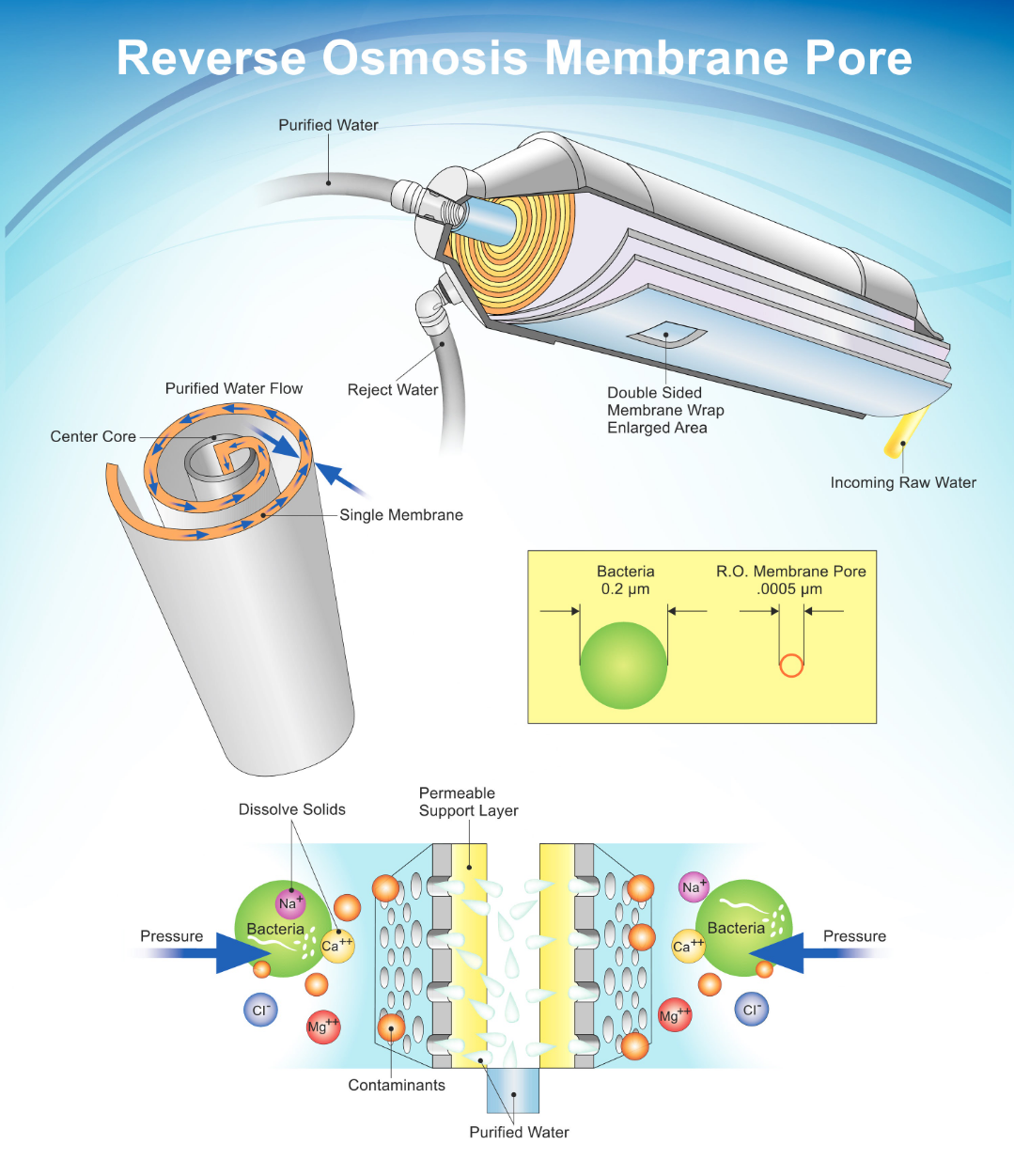 output water.
Similar products

